




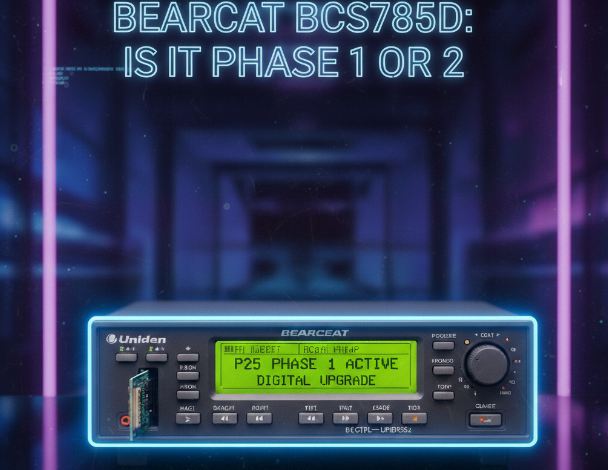
If you’re into the world of radio scanning, you know that technology changes quickly. A common question that comes up for owners of older, reliable scanners is about their digital capabilities. You might be looking at your trusty Uniden Bearcat BC785D and wondering where it stands with modern digital trunking systems. This leads to the central question: bearcat bcs785d is it phase 1 or 2 capable? Let’s dive deep into this topic to give you a clear and straightforward answer. We’ll explore the scanner’s features, what Phase 1 and Phase 2 mean, and what your options are in today’s scanning environment.
Understanding Radio Scanner Technology
Before we can determine the capabilities of the BC785D, it’s helpful to understand the basics of scanner technology. Scanners have evolved from simple devices that could only pick up analog frequencies to sophisticated computers that can follow complex, encrypted communication systems. This evolution was driven by public safety agencies moving from older, easy-to-monitor analog systems to more efficient and secure digital ones.
This shift created a divide in the scanner world. Older scanners were left unable to follow these new digital conversations, prompting manufacturers to develop new models with digital decoding capabilities. The Bearcat BC785D was a popular model during a key transitional period, making its exact features a frequent topic of discussion among hobbyists. Understanding its place in this technological timeline is key to knowing its limits.
What is a Trunking Scanner?
A trunking scanner is a radio receiver that can automatically follow conversations on a trunked radio system. Instead of assigning a specific frequency to each user group (like the fire department or police), a trunked system uses a pool of frequencies managed by a computer. The computer assigns a frequency to a group for the duration of a single conversation. This is incredibly efficient, as it allows many more users to share fewer frequencies.
The Bearcat BC785D is known for being an excellent trunking scanner. It can monitor various analog trunking systems, such as Motorola, EDACS, and LTR. This was a major feature when it was released, allowing users to seamlessly follow communications without manually programming every single frequency for every agency. The scanner handles the “trunk tracking” automatically, making the hobby much more accessible and enjoyable.
The Shift from Analog to Digital
The biggest change in two-way radio communication over the past few decades has been the move from analog to digital. Analog signals are like a wave, carrying voice as a direct electrical representation. Digital, on the other hand, converts the voice into binary code—ones and zeros. This offers several advantages, including clearer audio, better security, and the ability to transmit data alongside voice.
This transition is why you’ll hear terms like APCO Project 25 (P25). P25 is a standard for digital radio communications used by public safety organizations across North America. It ensures that agencies in different jurisdictions can communicate with each other during emergencies. The development of P25 happened in stages, or “phases,” which is where the heart of our main question lies. Answering the question of bearcat bcs785d is it phase 1 or 2 requires understanding these specific digital standards.
P25 Phase 1 vs. Phase 2: What’s the Difference?
To get to the bottom of the BC785D’s abilities, we need to clearly define P25 Phase 1 and Phase 2. While both are digital, they use the available radio spectrum in very different ways.
P25 Phase 1 Explained
P25 Phase 1 was the first digital standard widely adopted. It uses a technology called Frequency Division Multiple Access (FDMA). In simple terms, FDMA assigns one user or conversation to a single radio frequency at a time. It uses a 12.5 kHz wide channel for each conversation. So, if the police department is talking, they occupy that entire channel. When they finish, another group can use it. Phase 1 was a major leap from analog, offering digital clarity and some data capabilities, but it was still limited to one conversation per frequency.
P25 Phase 2 Explained
P25 Phase 2 was developed to be even more spectrally efficient. It uses a technology called Time Division Multiple Access (TDMA). TDMA is a clever system that splits a single 12.5 kHz frequency into two distinct time slots. This allows two separate conversations to happen on the same frequency at the same time. One user group gets time slot 1, and another gets time slot 2. The radio rapidly switches between them, but the switch is so fast that it’s unnoticeable to the users. The main benefit is doubling the capacity of a single frequency, which is crucial in congested urban areas.
Comparison Table: Phase 1 vs. Phase 2
Feature | P25 Phase 1 | P25 Phase 2 |
|---|---|---|
Technology | FDMA (Frequency Division Multiple Access) | TDMA (Time Division Multiple Access) |
Channel Access | One user per frequency channel | Two users (time slots) per frequency channel |
Channel Bandwidth | 12.5 kHz | 12.5 kHz (effective 6.25 kHz per user) |
Spectral Efficiency | Standard | High (double the capacity of Phase 1) |
Scanner Compatibility | Requires a Phase 1 capable digital scanner | Requires a Phase 2 capable digital scanner |
The Big Question: Bearcat BC785D Is It Phase 1 or 2?
Now we arrive at the direct answer. The Uniden Bearcat BC785D is an analog-only scanner. It is not capable of monitoring any P25 digital systems, whether Phase 1 or Phase 2.
While it is an advanced analog trunking scanner, it was designed and released before digital voice decoding became a standard feature in consumer-grade scanners. The BC785D does not have the necessary hardware (a digital decoder card or chip) to interpret P25 digital signals. Therefore, if your local public safety agencies have migrated to a P25 Phase 1 or Phase 2 system, your BC785D will only be able to pick up the un-decoded, “buzzing” noise of the digital control channel or voice traffic. You will not be able to hear any of the conversations.
Why the Confusion Exists
The confusion often arises because the BC785D is a “digital tracking” scanner. However, this terminology refers to its ability to track digital control channels on analog trunking systems (like Motorola Type II). It can understand the data on the control channel that tells radios which analog voice frequency to switch to. It cannot, however, decode a digitally modulated voice transmission. This distinction is subtle but crucial. So, while the manual might mention “digital,” it’s not referring to P25 digital voice. The key takeaway is clear when you ask bearcat bcs785d is it phase 1 or 2—it’s neither.
What Can You Monitor with a Bearcat BC785D?
Even though it can’t handle digital systems, the BC785D is far from useless. There are still many signals it can receive, depending on your location.
- Conventional Analog Frequencies: This includes things like business radios, railroad operations, aviation, marine bands, and amateur radio repeaters.
- Analog Trunking Systems: Many areas, especially rural ones, still use older Motorola, EDACS, or LTR trunking systems. Your BC785D is perfect for monitoring these.
- Analog Public Safety: Some volunteer fire departments, small town police, or public works departments may still operate on analog frequencies.
- Weather Alerts: It can receive NOAA weather radio broadcasts, which are essential for staying informed about severe weather.
To see what systems are active in your area, an excellent resource is the RadioReference.com database. This user-maintained site provides detailed information on frequencies and system types for counties and states across the country, helping you determine if an analog scanner still has value where you live.
Options for Monitoring Digital Systems
If you’ve confirmed that your local agencies use P25 Phase 1 or Phase 2, you will need to upgrade your equipment. Fortunately, there are many modern scanners designed for this purpose. When you’re ready to make the switch, you can find a wealth of information and product reviews on sites like our own ncrmagazine.
Finding a Digital Scanner
When shopping for a new scanner, you’ll need to look for specific keywords in the product description:
- “P25 Phase 1”: This is the minimum requirement for monitoring most digital public safety systems.
- “P25 Phase 2” or “TDMA”: This is necessary if your area uses a Phase 2 system. Most modern digital scanners are Phase 2 capable, and they are always backward-compatible with Phase 1.
- “DMR” or “MotoTRBO”: This is another digital mode, popular with business and amateur radio users. Some scanners include this decoding capability.
- “ProVoice”: An older digital format that some EDACS systems used. This is less common but required in a few areas.
Investing in a scanner that covers both Phase 1 and Phase 2 is the most future-proof option. Many agencies are slowly upgrading to Phase 2 for its increased capacity, so having a scanner that can handle it will ensure you can continue to listen for years to come.
Conclusion
To wrap it all up, the question of “bearcat bcs785d is it phase 1 or 2” has a very direct answer: it is neither. The Uniden Bearcat BC785D is a powerful and well-regarded analog trunking scanner, but it was produced before P25 digital voice became common. It lacks the internal hardware required to decode any digital voice transmissions, including P25 Phase 1 and Phase 2.
While it remains a capable device for monitoring analog radio traffic, you will need to invest in a modern digital scanner if your local emergency services have moved to a P25 system. By checking online databases for your area and understanding the difference between the digital phases, you can make an informed decision and get the right equipment to enjoy the fascinating hobby of radio scanning.
Frequently Asked Questions (FAQ)
Q1: Can I upgrade my BC785D to receive digital signals?
A: Unfortunately, no. The BC785D was not designed with a slot for a digital decoder card. Unlike some other models from that era (like the BC796D), there is no official or aftermarket hardware upgrade to add digital capabilities.
Q2: How can I tell if my area uses Phase 1 or Phase 2?
A: The best way is to check the RadioReference.com database for your county. Look for the system your local agencies use and check the “System Type.” It will clearly state if it’s “P25 Phase I” or “P25 Phase II.”
Q3: Will a Phase 2 scanner work for Phase 1 systems?
A: Yes, absolutely. All P25 Phase 2 scanners are fully backward-compatible and can monitor P25 Phase 1 systems without any issues. This makes a Phase 2 scanner a safe and future-proof purchase.
Q4: Is it still worth buying a used Bearcat BC785D today?
A: It depends on your needs. If you live in an area with a lot of analog trunking systems or are interested in monitoring things like railroads, aviation, and businesses that still use analog, the BC785D is a durable and affordable option. However, if your primary interest is public safety, you should first confirm they haven’t switched to digital.